
Integration Services
Disconnected Systems Integration Services
Connect business systems, data, and operational processes
PineSucceed Technologies Pvt Ltd integrates applications, platforms, databases, and external services so information can move reliably across the organization.
We design integration architectures, develop APIs and middleware, synchronize data, modernize point-to-point connections, and establish monitoring for critical information flows.

Common Challenges
What we address
- Duplicate information stored in multiple systems
- Manual transfer of data between departments
- Inconsistent customer, product, or financial records
- Point-to-point integrations that are difficult to maintain
- Delayed synchronization
- Limited visibility into integration failures
- Legacy applications without modern interfaces
- Uncoordinated cloud and on-premise environments
- Third-party services operating in isolation
- Reporting affected by conflicting data

Systems Integration
Service capabilities
We connect applications, platforms, data, and external services so information moves reliably across your organization.
Integration strategy and architecture
We assess the application landscape, data flows, dependencies, security requirements, and future roadmap to define an appropriate integration model.
- Application landscape
- Data flows and dependencies
- Security requirements
- Future roadmap
An integration model chosen for your landscape and roadmap.
API design and development
We develop secure REST, GraphQL, and event-driven APIs with documented contracts, authentication, validation, versioning, and monitoring.
- REST, GraphQL, and event APIs
- Documented contracts
- Authentication and validation
- Versioning and monitoring
Secure, documented APIs that other systems can rely on.
Enterprise application integration
We connect CRM, ERP, finance, HR, supply-chain, customer-service, e-commerce, content, identity, and custom applications.
- CRM and ERP
- Finance and HR
- Supply chain and e-commerce
- Identity and custom applications
Business applications that share information instead of working in isolation.
Middleware and integration platforms
Middleware can manage transformation, routing, orchestration, retries, error handling, and communication between systems.
- Transformation and routing
- Orchestration
- Retries and error handling
- System-to-system communication
A managed layer that keeps communication between systems reliable.
Data synchronization
We implement scheduled, event-driven, batch, or near-real-time synchronization while addressing conflicts, duplication, validation, and source ownership.
- Scheduled and batch
- Event-driven and near-real-time
- Conflict and duplicate handling
- Source ownership
Consistent records across systems, synchronized at the right frequency.
Legacy system integration
Older platforms can be connected through adapters, middleware, database interfaces, file exchange, messaging, or controlled automation.
- Adapters and middleware
- Database interfaces
- File exchange and messaging
- Controlled automation
Older platforms connected without a full replacement.
Cloud and hybrid integration
We connect cloud applications, on-premise platforms, data environments, and external services across secured network boundaries.
- Cloud applications
- On-premise platforms
- Data environments
- Secured network boundaries
Cloud and on-premise systems working as one environment.
Integration monitoring and support
Monitoring provides visibility into transaction status, failures, latency, retries, dependencies, and service availability.
- Transaction status
- Failures and retries
- Latency and dependencies
- Service availability
Clear visibility into the health of every critical information flow.
Our Approach
Delivery framework

We document systems, owners, interfaces, data sources, dependencies, and current integration methods.
We identify how information should move, which platform owns each record, and what transformations are required.
We select the integration patterns, API standards, security controls, middleware, and operational model.
Interfaces, transformations, workflows, validation rules, and monitoring are implemented.
We test accuracy, security, performance, failure handling, and reconciliation before production rollout.
Documentation, monitoring, support procedures, and ownership are established for ongoing reliability.
The Results
Business outcomes
-
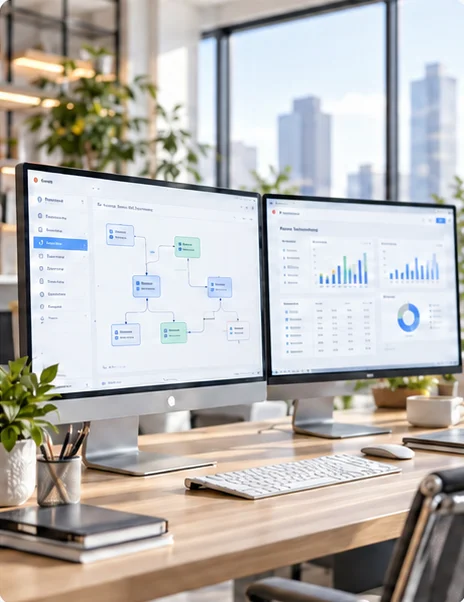
Consistent information across systems
-
Reduced manual data transfer

-
Faster cross-department processes

-
Improved reporting accuracy
-
Fewer duplicate records

-
Better customer and employee experiences

-
More reliable third-party integrations

-
Simpler maintenance and troubleshooting

-
A stronger foundation for automation and analytics

FAQs
Frequently Asked Questions
Yes. Integration can connect commercial platforms, cloud services, custom software, databases, and legacy applications when suitable access methods are available.
Alternative approaches may include database interfaces, secure file exchange, messaging, custom adapters, or robotic process automation.
No. Real-time integration is appropriate only when the business process requires it. Scheduled or batch synchronization may be simpler and more economical for other use cases.
We define ownership rules, unique identifiers, validation, matching logic, conflict-resolution procedures, and reconciliation reporting.
Yes. High-risk or high-value connections can be prioritized and replaced in phases without changing the entire environment at once.

Let’s Talk
Establish a connected
technology environment
PineSucceed can assess your current systems and create an integration roadmap that supports reliable operations, automation, and future growth.