PineSucceed Technologies Pvt Ltd helps businesses integrate
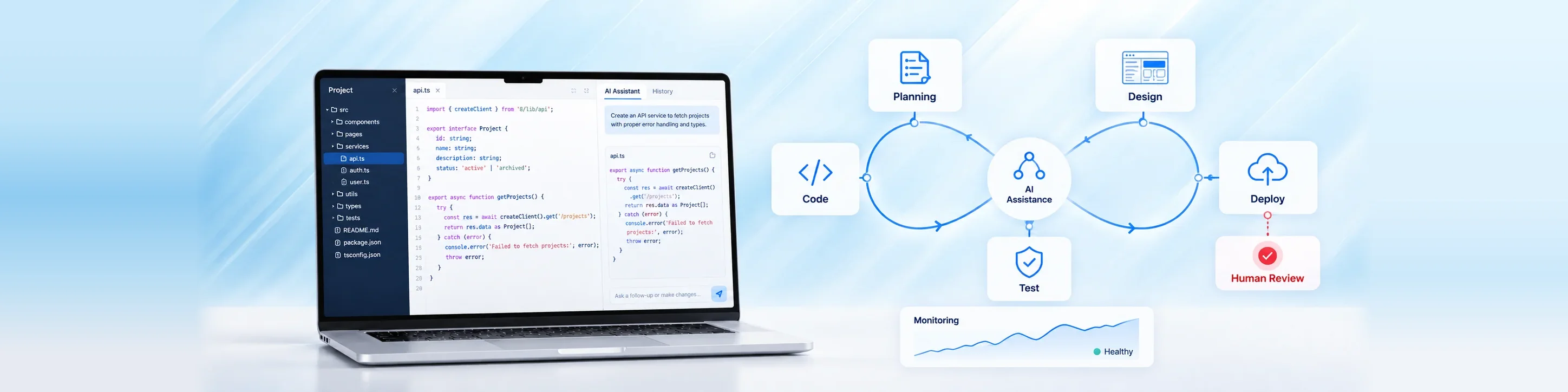
artificial intelligence across the software development life cycle
(SDLC) to improve planning, accelerate delivery, strengthen
quality, and support continuous improvement.
From requirements and architecture to development, testing,
deployment, and maintenance, we apply AI where it creates
practical value without compromising security, governance, or
engineering discipline.
Our Capabilities
AI Across SDLC Services We Offer
Practical AI support from discovery through long-term operations.
Explore the life cycle
01 /
Discovery
AI-Assisted Discovery and Requirements Engineering
We use AI to help teams convert business ideas, stakeholder
inputs, support requests, and existing documentation into
clearer, more actionable software requirements.
Our requirements engineering support includes
Stakeholder input analysis
Requirement extraction and classification
User story and acceptance criteria drafting
Requirement gap and conflict identification
Backlog organization and prioritization
Traceability support
Change-impact analysis
The Outcome
Transform Software Delivery with AI
AI-Driven Engineering Productivity
We identify high-value opportunities where AI can reduce
repetitive work, accelerate analysis, and help teams focus on
architecture, product decisions, and customer value.
With PineSucceed, you get:
Faster requirements and design cycles
Improved developer productivity
Earlier defect detection
Better test coverage
More efficient delivery operations
Clear governance and human oversight
Engineering-First AI Adoption
AI should strengthen software engineering practices, not
replace them. Our approach combines automation with
experienced review, secure processes, and measurable delivery
outcomes.
Key questions we help answer
Where can AI create the most value in our SDLC?
Which tools and models suit our teams?
How do we protect source code and business data?
Which outputs require human review?
How can AI fit existing workflows?
How do we measure productivity and quality?
How should we scale adoption?
Our Approach
Our AI Across SDLC Implementation Process
From understanding the way you build software to scaling AI with
clear controls and measurable results.
Step 01
SDLC Discovery and Workflow Assessment
Understand your workflows, tools, teams, and delivery
goals.
Step 01 / 06
SDLC Discovery and Workflow Assessment
We begin by understanding your product delivery process,
team structure, technology stack, tools, pain points, and
business goals.
Key activities:
Stakeholder and team discussions
Current SDLC mapping
Toolchain and repository review
Bottleneck identification
Security and compliance assessment
Success criteria definition
Step 02
AI Readiness and Risk Assessment
Establish the foundation for safe, practical AI adoption.
Step 02 / 06
AI Readiness and Risk Assessment
We evaluate the organization's readiness to use AI in
engineering workflows, including data access, source-code
sensitivity, infrastructure, governance, and team adoption.
Assessment areas include:
Code and data classification
Tool integration readiness
Privacy and intellectual property risks
Security and compliance requirements
Model and platform suitability
Team skills and change readiness
Baseline delivery metrics
Step 03
Use Case Identification and Prioritization
Focus on the opportunities that create the most value.
Step 03 / 06
Use Case Identification and Prioritization
We identify AI use cases across the SDLC and prioritize them
according to business value, engineering impact,
implementation effort, risk, and measurability.
Common priority use cases include:
Requirements and user story assistance
Developer coding assistants
Automated code review
Test generation and maintenance
Defect triage
Build and deployment analysis
Incident and knowledge assistance
Step 04
Solution and Governance Design
Design the workflow, safeguards, and measures for success.
Step 04 / 06
Solution and Governance Design
We define the target workflow, integrations, models,
security controls, review points, and measurement framework
for the selected use cases.
Design deliverables include:
Recommended AI-SDLC architecture
Tool and model recommendations
Integration approach
Access and data-control model
Human review workflow
Quality and safety guardrails
KPIs and adoption plan
Step 05
Pilot and Validation
Prove usability, quality, security, and measurable impact.
Step 05 / 06
Pilot and Validation
We launch a focused pilot with a suitable project or team to
validate usability, output quality, productivity impact,
security, and adoption before broader rollout.
Pilot activities include:
Pilot scope definition
Workflow configuration
Team onboarding
Prompt and template development
Quality benchmarking
Usage and outcome measurement
Feedback and improvement cycles
Step 06
Rollout, Integration, and Continuous Improvement
Scale adoption across teams and keep improving outcomes.
Step 06 / 06
Rollout, Integration, and Continuous Improvement
After a successful pilot, PineSucceed supports integration,
team rollout, governance, measurement, and ongoing
optimization.
Support areas include:
Toolchain integration
Team training and enablement
Reusable prompt and workflow libraries
Usage monitoring
Policy and governance updates
Performance optimization
Expansion to additional teams and use cases
Use Cases
AI Across SDLC for Different Business Goals
Different business goals. Focused AI applications across the
software lifecycle.
Accelerate software delivery
AI-assisted planning, coding, testing, and release workflows
Improve software quality
Code review, defect detection, test generation, and
traceability
Modernize legacy applications
Code understanding, documentation, refactoring, and
migration support
Reduce operational effort
Build analysis, incident triage, monitoring, and runbook
assistance
Strengthen security
Secure coding assistance, vulnerability review, and
governance controls
Improve engineering knowledge
Repository search, documentation, onboarding, and knowledge
assistants
Standardize engineering practices
Reusable workflows, policies, review gates, and quality
metrics
Scale product teams
AI-enabled collaboration, planning, documentation, and
developer support
Tools & Technologies
Technologies and Platforms We Work With
We connect proven tools across the software lifecycle to deliver
AI solutions that fit your engineering environment.
AI Models and Platforms
OpenAI, Azure OpenAI, Gemini, Amazon Bedrock, and
open-source LLMs
Source Control
GitHub, GitLab, Bitbucket, and Azure Repos
Project Management
Jira, Azure Boards, and related agile delivery tools
Development
Modern IDEs, code assistants, APIs, and custom engineering
copilots
Testing
Unit, API, UI, performance, and security testing frameworks
CI/CD and DevOps
GitHub Actions, GitLab CI/CD, Azure DevOps, Jenkins, Docker,
and Kubernetes
Cloud
AWS, Microsoft Azure, and Google Cloud
Observability
Logs, metrics, traces, monitoring platforms, and
incident-management integrations
Knowledge and Search
Documentation repositories, vector databases, semantic
search, and RAG systems
Our Approach
Why Choose PineSucceed for AI Across
SDLC?
AI delivers value when it fits the way your teams actually
build, release, and operate software.
We focus on workflows that solve real delivery problems
and produce measurable improvements in speed, quality, and
engineering effectiveness.
Our team understands product discovery, architecture,
software development, quality engineering, DevOps, cloud,
and post-launch operations.
AI-generated recommendations and artifacts remain subject
to the right level of human review, validation, and
accountability.
We design AI-assisted workflows with source-code
protection, data privacy, access controls, traceability,
and compliance considerations in mind.
We align AI capabilities with your existing repositories,
project-management tools, testing frameworks, CI/CD
pipelines, cloud platforms, and operational systems.
PineSucceed can support assessment, strategy, pilot
delivery, integration, enablement, rollout, monitoring,
and continuous improvement.
The Value
Benefits of AI Across the SDLC
Less repetitive work. Faster feedback. Better decisions throughout
product delivery.
Delivery momentum
Faster software delivery
Improved developer productivity
Clearer requirements and documentation
Engineering quality
Earlier defect identification
Better test coverage
Reduced technical debt
Operational confidence
More reliable releases
Faster incident resolution
Improved engineering knowledge sharing
Sustainable scale
Consistent development practices
Measurable workflow improvement
Scalable AI adoption
Let’s Talk
Ready to Bring AI Across Your SDLC?
Our team helps you move from experimentation to
secure, measurable adoption at the pace that fits your
business.
FAQs
Frequently Asked Questions
AI across the SDLC means applying artificial intelligence to
support activities throughout software delivery, including
requirements, planning, design, coding, review, testing,
deployment, monitoring, maintenance, and documentation.
No. AI is best used as an assistant that accelerates repetitive
work, improves analysis, and provides recommendations. Skilled
professionals remain responsible for architecture,
implementation decisions, review, validation, security, and
accountability.
The best starting point depends on your bottlenecks, risks, and
available data. Many organizations begin with developer
assistance, test generation, documentation, defect triage, or
engineering knowledge search before expanding further.
Yes. We design AI-assisted workflows around your existing
repositories, IDEs, project-management tools, testing
frameworks, CI/CD platforms, cloud services, monitoring systems,
and documentation sources.
We assess data sensitivity and recommend approved models, access
controls, retention settings, isolation approaches, review
policies, and monitoring appropriate to your security and
compliance requirements.
Yes. AI can assist with code understanding, dependency analysis,
documentation, test creation, refactoring recommendations,
migration planning, and knowledge transfer. Human engineers
validate all modernization decisions and outputs.
We establish baseline and target metrics such as cycle time,
lead time, review time, defect escape rate, test coverage, build
success, incident resolution time, adoption, output acceptance,
and developer satisfaction.
PineSucceed can provide strategy and assessment as standalone
services or continue through pilot development, integrations,
rollout, training, governance, monitoring, and optimization.
AI-generated code should follow the same engineering controls as
human-written code, including peer review, automated testing,
security scanning, quality checks, and controlled deployment.
The timeline depends on scope, integrations, governance
requirements, and the number of teams involved. A focused
assessment or pilot may take a few weeks, while broader adoption
is usually delivered in phases.
Explore more
Related services and industries
Request a Proposal
Tell us about your project. Our team will get back to you.
✨
Thank you! Your request has been received.
Our sales team will review your requirements and follow up within 24 business hours.